Dr. Amanda Hansford, DVM
Veterinarian · Nashville, TN · 14 Years in Practice
You know your dog better than anyone else in the world.
And you know when something is off.
Not dramatically off. Nothing you could point to in a vet's office. Just a quiet thing you've been pushing to the back of your mind for months.
The way they get up from the floor takes a moment longer. On walks, you've started slowing down without realizing it. You're the one adjusting your pace now.

You know this dog. You know when something is different.
You haven't talked about it. Because what would you even say? The bloodwork is fine. The vet said he's healthy. Maybe it's just age.
You've been telling yourself that for a while now.
And yet.
- They sleep deeper and longer than they used to. Mornings take more to get going.
- The sprint across the room when you pick up the leash is quieter now. The excitement is still there. But something is different.
- The paws they lick every night. Three food changes. Your vet says allergies. It keeps coming back.
- Their coat. Their eyes. Something you feel more than see.
- That thing you can't put a word to. The dog in front of you and the dog from two years ago aren't quite the same.
You've probably mentioned one of these at a vet visit. You know how that conversation ended.
"He's just getting older. It's pretty normal at this age."
You went home. You told yourself it was fine.
But It Hasn't Felt Fine.
There's a thought you haven't said out loud. The one that comes late at night, or right when you're watching him sleep on the couch.
You've done the math. You know roughly how long dogs live. You know how old he is. And if you're honest, you know what that means about where you are right now.
The second half goes faster than the first. You've heard people say that. You're starting to feel what they mean.
You don't want to lose him. Not to something that was preventable. Not to something that's been building quietly for years while you were telling yourself he was fine.
That low-grade feeling you carry every time you notice he's a little slower, a little quieter, a little less like himself.
That feeling isn't nothing. That feeling is important.
Because it turns out, the things you've been noticing have a reason. And almost nobody is talking about it.
These Symptoms Aren't Random. And They Aren't Just Age.
They're not separate problems requiring separate solutions either.
There's a single gap in your dog's biology. One your vet has almost certainly never tested for. One that no dog food manufacturer in America is legally required to address. One that connects every symptom on that list.
It affects the heart muscle. The immune system. The eyes. The rate at which your dog ages at a cellular level.
And it starts widening the moment a dog turns four or five.
I know this because I spent 14 years telling dog owners the wrong thing. I was that vet. Sending people home with the normal answer.
I don't say it anymore.
I Was Part of the Problem for 14 Years
My name is Dr. Amanda Hansford. I've practiced veterinary medicine in Nashville for 14 years. I have a black lab named Scout who is 9 years old and still, on good days, acts like he's 3. I love this work and I love my patients.
And I have to tell you something honest: for most of my career, I was giving dog owners the wrong answer to the wrong question.
When a dog came in with low energy, recurring skin issues, a coat that had changed, a cough that came and went, I ran bloodwork. If the bloodwork came back normal, I said what every vet says. What you've probably heard from your own vet:
"She's just getting older. It's pretty normal at this age."
I wasn't wrong exactly. The bloodwork was normal. The dog wasn't sick by any standard measure I'd been trained to use. But I was missing something that isn't in our curriculum. Something a standard panel doesn't even test for.
I found it at a continuing education conference two years ago, over a lunch I wasn't expecting. A veterinary cardiologist from a university program sat down next to me and pulled up a study on her phone. UC Davis, dogs with cardiac changes that had measurably improved after taurine supplementation. Fifteen out of sixteen. Then she asked how many owners that year I'd told their dog's symptoms were just aging.
I didn't answer. I didn't need to.
I went back to my hotel room that night and spent three hours reading. I canceled dinner. By midnight I was thinking about every patient I'd sent home with that answer over 14 years.
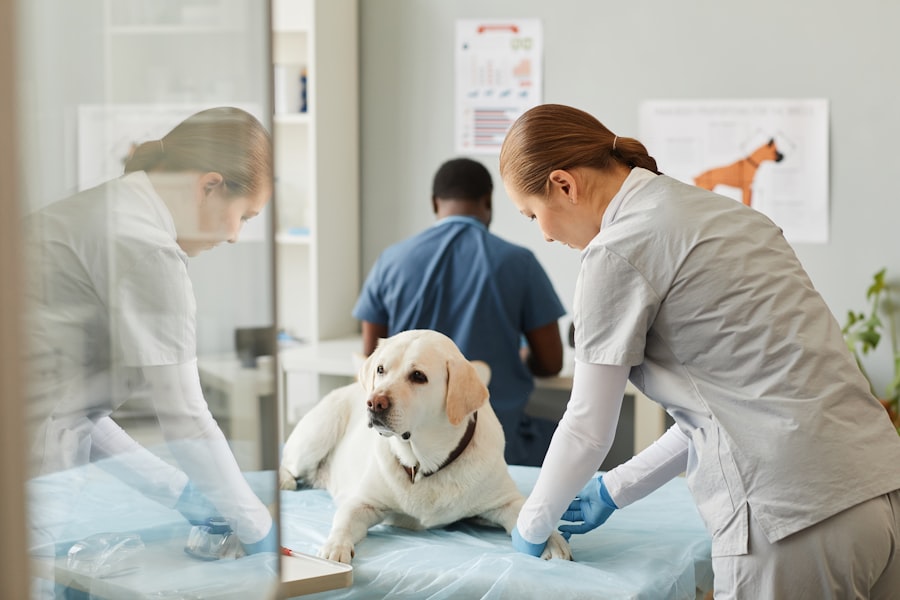
The standard lab panel doesn't test for taurine levels. A normal result and a taurine gap can coexist in the same dog.
What Your Dog's Food Is Not Required to Contain
Here is what the research led me to. Follow this carefully, because it changed how I practice.
Every bag of dog food sold in America, every brand, every price point, every formula stamped "complete and balanced", is formulated to standards set by AAFCO, the Association of American Feed Control Officials. Their guidelines cover protein, fat, calcium, phosphorus, vitamins, dozens of nutrients.
Taurine is not on the list.
AAFCO requires zero dietary taurine in dog food. Not a trace. Zero. A bag of premium food can contain no taurine at all and still carry the "complete and balanced" guarantee. That is not an accusation. That is the current regulatory standard, and it hasn't changed.
"A bag of dog food can be legally stamped 'complete and balanced' and contain no taurine at all. That's not a failure. That's the standard as written."
Dogs can synthesize some taurine on their own. So the assumption was that a good protein source would cover the need automatically. That standard was set before we understood how variable that synthesis pathway actually is. It's least efficient in larger breeds, where body mass outpaces production. And as dogs age, the pathway becomes less reliable, precisely when the body's demand for taurine increases.
The gap is widest in the dogs most owners reading this are raising right now. Dogs over five. Medium and large breeds. Dogs on perfectly normal food that meets every claim the label can legally make.
0
Taurine required by AAFCO in "complete & balanced" dog food
15/16
Dogs showed cardiac improvement in the UC Davis taurine study
+12%
Increase in healthy lifespan. 2023 Columbia/UTSW Science study
What Those Symptoms Are Actually Telling You
Once I understood what taurine governs in the body, I understood why I had been missing a root cause hiding behind symptoms I was dismissing one by one.
Taurine is concentrated in the highest-demand tissues. It affects the heart muscle, the eyes, the immune cells, the brain. When it runs chronically low, it doesn't announce itself. It doesn't appear in a standard panel. It shows up as the things you've been noticing and explaining away.
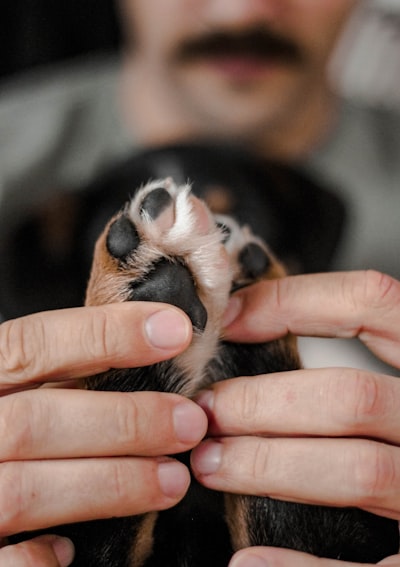
The paws they lick every night. Something is telling you this isn't just allergies.
The paw licking that hasn't resolved despite three food changes: taurine governs how immune cells regulate their own response. When levels drop, those cells can activate against a trigger but lose the ability to turn off. They begin generating inflammation against things a healthy immune system would simply ignore. The body is essentially fighting itself. That's what you're watching on the floor at midnight. The food changes never worked because food was never the problem.
The dog who used to run to the door and now walks: taurine makes up more than half the free amino acids in cardiac muscle tissue. When levels fall, those muscle cells weaken and the heart has to work harder to pump the same volume of blood. Over time, the chambers can begin to enlarge as the heart tries to compensate. This is the exact biological process the UC Davis study was measuring. The dogs who showed it first weren't in crisis. They were just dogs who turned around a block earlier on walks. No dramatic sign. Just a heart that's quietly losing ground.
The coat that changed, the heavier sleep, the eyes that seem different: taurine accounts for roughly half the free amino acids in retinal tissue. When levels decline, the photoreceptor cells that process vision begin to degenerate slowly and silently. You notice it first as a gaze that seems slightly less sharp, or a dog that hesitates in low light. The coat and the heavier mornings follow the same logic. Taurine supports the cellular repair cycle throughout the body. When that cycle slows, the outermost tissues feel it first. The coat you can tell is different even if you can't explain it in a photo. The morning that takes longer to shake off than it used to.
And then there is the longer picture. A 2023 study published in Science, out of Columbia University and UT Southwestern, found that taurine supplementation extended healthy lifespan in mammals by approximately 12 percent. These were healthy animals. The benefit was cellular. Taurine maintained the internal environment that slows the biological process of aging itself.
Research Highlight
UC Davis Veterinary Cardiology Study: Of dogs with taurine-associated cardiac changes placed on supplementation, 15 out of 16 showed measurable improvement in cardiac function. These were not dogs in crisis. They were dogs whose owners had been noticing the same things you've been noticing. Caught it before it became irreversible.
Columbia / UT Southwestern (Science, 2023): Taurine supplementation in healthy mammals extended healthy lifespan by ~12%, with measurable slowing of cellular aging markers. The study authors described taurine deficiency as "a driver of aging and disease."

Sleeping more. Less excited. Lying there when he used to be first up. These signs connect.
The Honest Explanation: Why Your Vet Never Brought This Up
I know what you're thinking. If this is real, why hasn't my vet said anything?
I can answer that from the inside, because I was that vet for 14 years.
Veterinary school gives us one lecture on taurine. Maybe two. The framing is always the same: taurine deficiency is a concern in cats, watch for it with grain-free diets, otherwise a complete-and-balanced food should cover the need. We're trained to diagnose disease. We are not trained to look for a regulatory gap that produces gradual decline over years, quietly, in dogs who test normal on every metric we're equipped to use.
Standard bloodwork doesn't test taurine levels. There is no flag. We have a dog who looks healthy by every measure we were taught, and an owner who mentions she seems a little slower this year.
So we say the normal thing. She's just getting older.
I said it for 14 years. I don't say it anymore.
Why Most Taurine Supplements Don't Work
After that conference, I started recommending taurine supplementation to owners whose dogs fit the pattern. But before I recommended anything specific, I looked at what the market was actually offering.
What I found was genuinely disappointing.
Most products marketed as taurine support for dogs are multi-ingredient blends, taurine plus countless other fillers and compounds, all under a proprietary label that doesn't tell you how much of any individual ingredient is actually in there. The clinical research, including the UC Davis work, used single-ingredient taurine at doses around 500mg per day for a medium to large breed dog.
Most of the blends I reviewed were delivering 50 to 100mg of taurine at best, buried in a formula designed to look comprehensive on the label. Fifty milligrams is not a clinical dose. It is a label ingredient.
Sourcing was the other issue. Raw taurine is largely manufactured overseas and quality control varies widely. Third-party purity testing, the kind that tells you what's actually in the powder, was absent from almost everything I reviewed.
I was looking for something simple: one ingredient, 500mg, pharmaceutical-grade, USA-manufactured, third-party tested, no blend obscuring the dose. It took longer to find than it should have.
Dr. Hansford's Recommendation
The Only Taurine I Give My Own Dog
and Recommend to Every Patient Over 5
500mg single-ingredient taurine. USA sourced. Third-party tested. The dose the research actually used.
Try HappyWags: 60 Days Risk Free →
I only put my name behind products I give Scout. This is one of them. Dr. A. Hansford
What I Now Recommend
The product I landed on is called HappyWags. Pure taurine powder. One ingredient. 500mg per scoop, the dose that matches the clinical research. Pharmaceutical-grade taurine, sourced and manufactured in the USA, with third-party purity testing.
No blend. No hidden dose. You know exactly what your dog is getting.
One scoop in the morning bowl. Most dogs don't notice it. That is the entire protocol.
I've been recommending it for over a year. The pattern I see consistently: energy on walks comes back first. Coat quality follows over weeks. Immune presentation improves. The owners watching most closely notice it earliest. A few have sent me messages I didn't expect, about a dog who started running to the door again after a year of walking. About a coat a vet noticed before the owner said anything.
This isn't about treating a disease. It's about closing a gap the regulatory system never required anyone to address. You can do that for your dog starting today.
What Owners Are Reporting
Jackson is a 9-year-old black Lab. He had stopped finishing our morning walks about eight months before I started him on taurine. Three weeks in he was finishing them. Six weeks in he was asking for longer ones. I cried the first time he ran to the door. That hadn't happened in over a year.
My Golden had been licking her paws every single night for two years. We tried four foods. Told it was environmental allergies every time. By week four on HappyWags she stopped. Completely. Her coat started changing at the same time. My vet noticed at her last checkup before I said anything.
My Doberman is 7. His father had cardiac issues and died at 9. I have been scared for years. His cardiologist mentioned taurine after his last echo and I ordered HappyWags that same week. Six months in his follow-up showed stable function. I can't say exactly what to attribute that to. But I'm not stopping. Not ever.
Three Questions I Get Every Time
My vet has never mentioned this. Does that mean my dog is fine? Standard bloodwork doesn't include taurine levels. A normal panel and a taurine gap can exist in the same dog at the same time. Your vet isn't overlooking something they were trained to find. It is not in the standard diagnostic picture. That's a curriculum gap, not a clinical failure. I say that as someone who had the same gap for 14 years.
My dog seems healthy. Why supplement? The dogs in the UC Davis data were described as healthy by their owners. The changes were in the cardiac muscle before they appeared in behavior. Taurine is water-soluble, excreted naturally. There is essentially no risk in supplementing a healthy dog with a clean single-ingredient product at a reasonable dose. The risk runs the other direction.
My dog is already 10 or 11. Is it too late? The improvement data included older dogs. Cellular mechanisms don't have age cutoffs. The goal with an older dog isn't reversing what happened. It's giving every year that remains the best possible internal environment. That is always worth doing.
My Recommendation
If you've recognized your dog in anything above, I'd start this week.
This is the only taurine I give Scout and recommend to patients. 500mg. One ingredient. One scoop in the bowl.
Try HappyWags: 60 Days Risk Free →
Dr. A. Hansford, DVM
One more honest thing before I finish.
You're going to close this in a minute. And you'll have one of two responses.
The first: you'll think it was interesting, mean to look into it, and life will move on. The link will get buried in your phone. Three months from now something will happen. A bad vet visit, a walk that ends too early, a night you can't stop Googling, and you'll try to remember what you read. Maybe you'll find it again.
The second: you'll go to the site, take a few minutes to order, and add one scoop to his bowl tomorrow morning. That's it.
Both roads lead somewhere. One is more vet visits that come back normal, watching him slow down a little more each month, being told it's just normal aging. The other is finally addressing the actual cause. One scoop a day. In six weeks, your dog might be pulling you down the block instead of turning around. Acting more like the dog you remember from three years ago.
I'm not trying to pressure you. I've watched too many owners wish they had started something earlier to pretend the timing doesn't matter. If your dog is over five, the window for preventive action is now. Not because something is definitely wrong. Because the best time to close a gap is before it becomes a deficit that shows up in a vet's office.
Dr. Hansford's Clinic Recommendation
The Supplement I Give to Every Dog Over 5
One scoop in the morning bowl. 500mg single-ingredient taurine. The dose the UC Davis research used. The only product I recommend to patients by name.
Try HappyWags: 60 Days Risk Free
Taurine depletes daily. Starting today means results by week 6.
500mg Clinical Dose
Single Ingredient
USA Manufactured
Third-Party Tested
Dr. Amanda Hansford, DVM
Veterinarian, Nashville TN
Scout is doing well. He still beats me to the door most mornings.